
Want more citations? Cut your title.
My analysis of 41,658 philosophy articles from recent years shows a clear pattern: shorter titles tend to get more citations. The effect is small but real. And it persists even after controlling for confounds.1
1 I used Claude Code heavily to draft the code for this post, and I’ve borrowed from its explanations of some of the graphs in my write up. Notably, Claude really doesn’t like short titles, even when writing about short titles.
1 The Data
I analyzed philosophy articles published between 2015 and 2024 across 100 prominent journals. These aren’t just any citations; I’m tracking citations within this network of 100 journals.
The full sample consists of 41,658 articles. The citation network includes every instance where one article in my dataset cites another article also in the dataset. I analyzed articles published between 2015-2024, with citations measured through 2024.
See Appendix A for the complete list of all 100 journals, including article counts and average citation rates.
2 The Basic Finding
Here’s the relationship in its simplest form:
Shorter titles correlate with more citations. The effect isn’t huge. But it’s there.
The average title length in my sample is 7.9 words, with a range from 1 to over 30 words. Yes, some philosophy titles are sentences. The shortest titles (1-4 words) actually perform best, though 5-7 word titles also do quite well.
3 Not Just Changing Norms
One concern you might have is whether this is just a spurious time trend. Perhaps titles have been getting longer over time, and citation rates have also been falling for unrelated reasons, and the two trends just happen to coincide?
Nope. Look within each year:
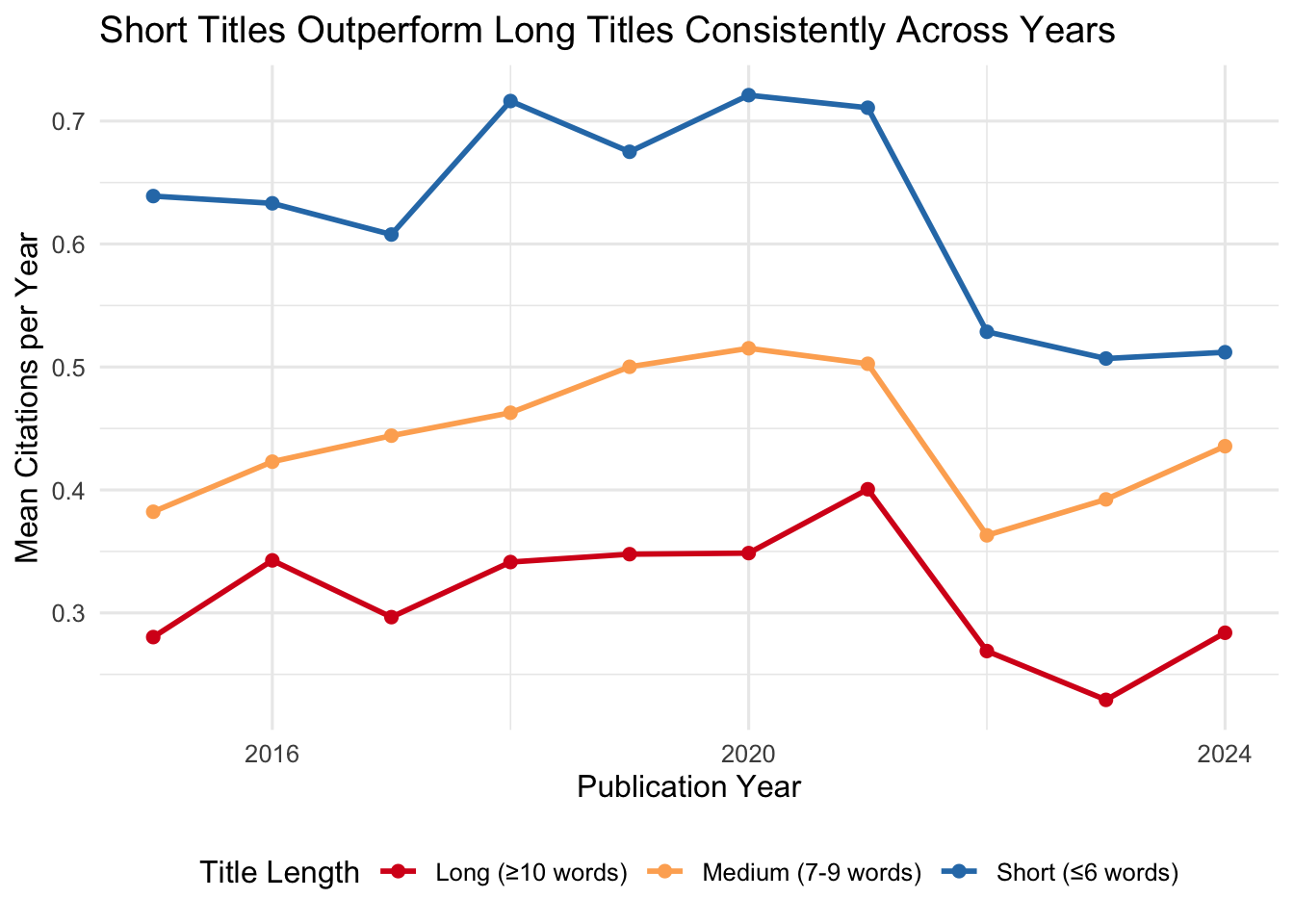
Year after year, the pattern holds. Short titles outperform long titles. Medium titles sit in between. This isn’t about evolving norms in title length. It’s a real within-year effect.
Title length has been creeping up slightly (from 7.7 words in 2015 to 7.9 words in 2024). But the citation advantage for shorter titles persists throughout.
4 The Journal Prestige Confound
Things get more complicated here. It’s possible that shorter titles don’t actually cause more citations. Perhaps articles with shorter titles simply tend to get published in more prestigious journals, and it’s really the journal venue that’s driving the citation advantage.
I tested this hypothesis by looking at whether the effect persists within journals.
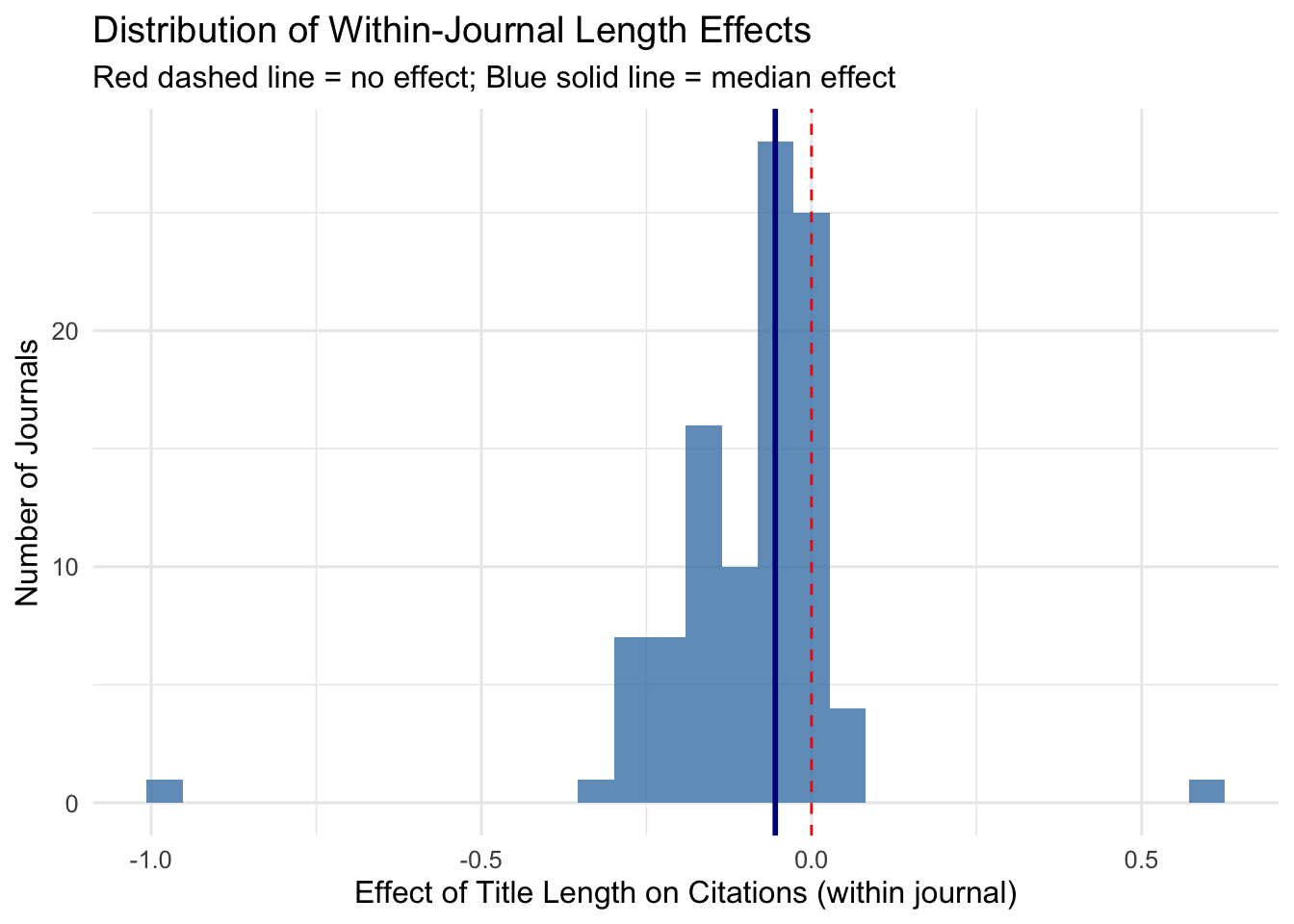
There’s still an effect, though it’s not as dramatic. Here’s what happens if we isolate 20 prominent (i.e., highly cited in the dataset) journals:
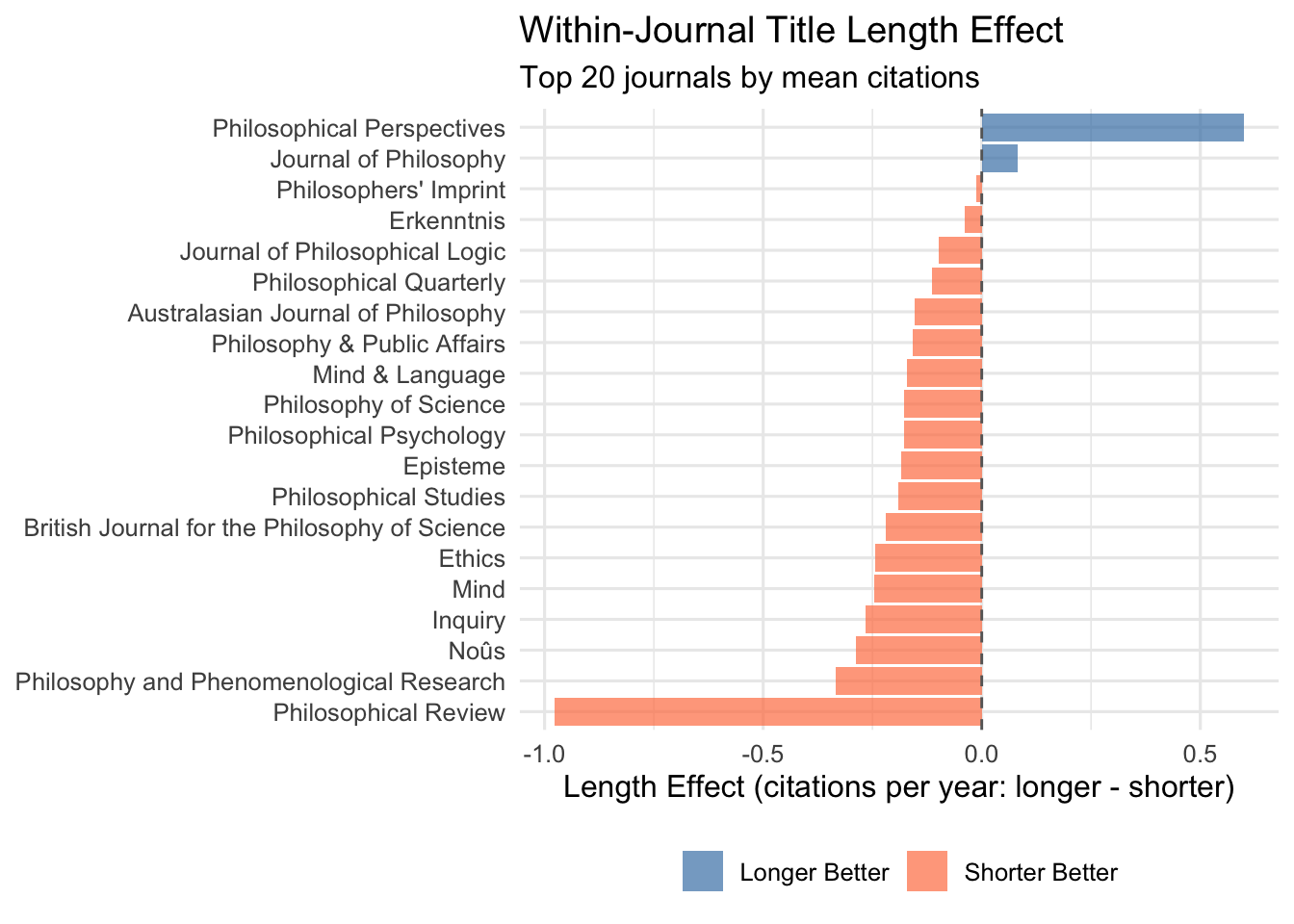
The results reveal that both factors appear to matter. Even holding journal fixed, short articles tend to do better. So length is mattering alongside prestige.
I built three really basic regression models. The first just compared title length and citations, the second added a year variable, the third added a journal prestige variable. Here are the effect sizes from these models:
- Raw correlation (title length vs citations): -0.036
- Controlling for year: -0.036
- Controlling for year + journal: -0.014
The effect does shrink substantially when I control for journal venue, but it doesn’t disappear entirely. This suggests that both the direct effect of title length and the indirect effect through journal selection are playing a role.
5 Two Interpretations
There are at least two ways to interpret these findings:
The direct interpretation: Writing shorter titles may actually help you get more citations. Brevity makes titles more memorable and attention-grabbing. Readers are more likely to remember and cite papers with punchy titles. Shorter titles are also easier to mention in conversation and informal discussion.
The indirect interpretation: Shorter titles might help you get published in more prestigious journals, and it’s really the journal venue that’s driving most of the citation advantage. You can’t just arbitrarily shorten your title and expect citation magic to happen. You also need to get the paper into Phil Review. But maybe shortening the title helps with that.
The truth probably involves both mechanisms. Short titles might help you get published in better venues and help you get cited once published. The persistence of the within-journal effect suggests that title length itself has some direct impact on citations, independent of where the article appears. However, the venue effects are clearly substantial and perhaps even dominant.
6 Other Title Features (Bonus Findings)
While I was at it, I also tested several other title characteristics to see how they correlate with citation rates:
| Feature | High-Cited % | Low-Cited % | Difference |
|---|---|---|---|
| has_colon | 23.6 | 31.5 | -7.9 |
| has_quotes | 11.9 | 18.3 | -6.4 |
| has_dash | 15.2 | 17.7 | -2.4 |
| has_gerund | 24.4 | 26.4 | -2.0 |
| mentions_kant | 2.7 | 2.2 | 0.5 |
| has_moral | 4.3 | 3.8 | 0.4 |
| has_not | 1.9 | 1.4 | 0.4 |
| has_justice | 0.7 | 1.1 | -0.3 |
| has_analysis | 0.8 | 1.1 | -0.3 |
| has_empirical | 0.7 | 0.4 | 0.3 |
The colon effect is particularly striking. Philosophy loves the “Main Title: Explanatory Subtitle” format. But it might be hurting citation counts. This might be something for future posts.
7 Conclusion
If you want more citations, consider:
- Keep the title shorta;
- Skip the subtitle;
- Ditch the quotation marks; and
- Make it punchy.
Will this guarantee citations? No. It’s not that easy. But if you’ve got a choice between “Epistemic Justification and Normative Belief Attribution in Context-Dependent Frameworks” and “When Beliefs Need Reasons”, consider the short version.
8 Appendix A: Journal Statistics
| Journal | Articles | Avg Total Citations | Avg Cites/Year |
|---|---|---|---|
| Philosophical Review | 101 | 12.8 | 2.12 |
| Noûs | 413 | 11.4 | 2.05 |
| Mind | 328 | 8.2 | 1.47 |
| British Journal for the Philosophy of Science | 442 | 7.2 | 1.41 |
| Philosophy and Phenomenological Research | 725 | 6.5 | 1.23 |
| Philosophy & Public Affairs | 130 | 7.8 | 1.22 |
| Ethics | 241 | 7.4 | 1.17 |
| Episteme | 364 | 4.5 | 1.11 |
| Inquiry | 578 | 3.6 | 1.05 |
| Philosophical Perspectives | 129 | 7.1 | 1.02 |
| Journal of Philosophy | 247 | 5.9 | 0.98 |
| Australasian Journal of Philosophy | 531 | 5.0 | 0.95 |
| Mind & Language | 379 | 4.1 | 0.94 |
| Philosophical Studies | 1745 | 5.3 | 0.89 |
| Philosophers’ Imprint | 294 | 5.5 | 0.86 |
| Philosophical Quarterly | 453 | 4.1 | 0.78 |
| Erkenntnis | 985 | 3.2 | 0.76 |
| Journal of Philosophical Logic | 433 | 4.1 | 0.72 |
| Philosophy of Science | 784 | 4.1 | 0.71 |
| Philosophical Psychology | 589 | 2.8 | 0.68 |
| Analytic Philosophy | 190 | 3.3 | 0.65 |
| Pacific Philosophical Quarterly | 377 | 3.9 | 0.65 |
| Journal of Political Philosophy | 217 | 3.7 | 0.64 |
| Journal of the American Philosophical Association | 341 | 3.4 | 0.64 |
| Canadian Journal of Philosophy | 402 | 3.8 | 0.62 |
| Analysis | 496 | 2.9 | 0.59 |
| Review of Symbolic Logic | 363 | 3.1 | 0.59 |
| Economics and Philosophy | 201 | 2.8 | 0.56 |
| Synthese | 4051 | 3.0 | 0.55 |
| Ergo | 386 | 2.9 | 0.54 |
| Minds and Machines | 293 | 2.5 | 0.51 |
| Social Epistemology | 419 | 2.0 | 0.49 |
| Journal of Moral Philosophy | 226 | 2.6 | 0.48 |
| Studies in History and Philosophy of Science | 745 | 2.6 | 0.47 |
| Linguistics and Philosophy | 232 | 2.3 | 0.45 |
| American Philosophical Quarterly | 280 | 2.7 | 0.44 |
| Ethical Theory and Moral Practice | 591 | 2.4 | 0.44 |
| Philosophia Mathematica | 140 | 2.6 | 0.44 |
| British Journal of Aesthetics | 287 | 2.2 | 0.43 |
| Monist | 317 | 2.4 | 0.42 |
| European Journal of Philosophy | 655 | 2.2 | 0.41 |
| Topoi | 762 | 1.8 | 0.41 |
| Philosophical Explorations | 244 | 2.3 | 0.40 |
| Journal of Applied Philosophy | 477 | 1.9 | 0.39 |
| Thought | 219 | 2.5 | 0.39 |
| Utilitas | 237 | 2.3 | 0.39 |
| Ratio | 299 | 2.3 | 0.38 |
| Journal of Aesthetics and Art Criticism | 317 | 1.9 | 0.37 |
| Philosophy Compass | 651 | 2.9 | 0.37 |
| Politics, Philosophy and Economics | 189 | 2.0 | 0.37 |
| Philosophical Papers | 139 | 2.1 | 0.36 |
| Kantian Review | 246 | 1.7 | 0.34 |
| Journal of Social Philosophy | 301 | 1.4 | 0.31 |
| Biology and Philosophy | 469 | 2.2 | 0.30 |
| Res Philosophica | 293 | 2.2 | 0.30 |
| Journal of Consciousness Studies | 663 | 1.7 | 0.28 |
| Hypatia | 419 | 1.7 | 0.27 |
| Kennedy Institute of Ethics Journal | 160 | 1.6 | 0.27 |
| British Journal for the History of Philosophy | 529 | 1.2 | 0.26 |
| European Journal for Philosophy of Science | 480 | 1.8 | 0.26 |
| Journal of the History of Philosophy | 256 | 1.7 | 0.25 |
| Philosophy of the Social Sciences | 236 | 1.4 | 0.24 |
| Southern Journal of Philosophy | 329 | 1.5 | 0.24 |
| Studia Logica | 457 | 1.3 | 0.24 |
| Ethics and Information Technology | 408 | 1.4 | 0.23 |
| Metaphilosophy | 421 | 1.2 | 0.22 |
| Theoria | 334 | 1.2 | 0.22 |
| Journal of Value Inquiry | 355 | 1.1 | 0.21 |
| History and Philosophy of Logic | 206 | 1.0 | 0.20 |
| Kant-Studien | 235 | 1.1 | 0.20 |
| Philosophia | 1119 | 1.0 | 0.20 |
| Bulletin of Symbolic Logic | 147 | 1.0 | 0.19 |
| Journal of Medical Ethics | 1375 | 1.0 | 0.19 |
| Philosophy | 234 | 1.1 | 0.19 |
| Phronesis | 154 | 1.2 | 0.19 |
| Journal of Philosophical Research | 205 | 1.1 | 0.18 |
| Archiv für Geschichte der Philosophie | 179 | 0.9 | 0.17 |
| Law and Philosophy | 234 | 1.0 | 0.17 |
| Notre Dame Journal of Formal Logic | 301 | 1.1 | 0.17 |
| Philosophical Investigations | 211 | 0.7 | 0.17 |
| Social Philosophy and Policy | 261 | 1.1 | 0.15 |
| International Journal for Philosophy of Religion | 311 | 0.7 | 0.13 |
| Journal of Indian Philosophy | 335 | 0.8 | 0.13 |
| Journal of Symbolic Logic | 739 | 0.7 | 0.13 |
| Journal of the Philosophy of History | 188 | 0.6 | 0.12 |
| Russell | 67 | 0.6 | 0.11 |
| South African Journal of Philosophy | 346 | 0.6 | 0.09 |
| Croatian Journal of Philosophy | 221 | 0.6 | 0.08 |
| Dialogue | 333 | 0.4 | 0.08 |
| Philosophical Forum | 221 | 0.5 | 0.08 |
| Philosophy East and West | 441 | 0.5 | 0.08 |
| Transactions of the Charles S. Peirce Society | 208 | 0.6 | 0.08 |
| Logique et Analyse | 139 | 0.6 | 0.07 |
| Philosophy and Rhetoric | 229 | 0.4 | 0.07 |
| Review of Metaphysics | 192 | 0.3 | 0.05 |
| Theory and Decision | 558 | 0.3 | 0.05 |
| International Philosophical Quarterly | 222 | 0.3 | 0.04 |
| Heythrop Journal | 574 | 0.1 | 0.03 |
| Journal of Chinese Philosophy | 192 | 0.2 | 0.03 |
| Journal of the History of Ideas | 291 | 0.2 | 0.03 |
Download data: All journal statistics (CSV) | Full analysis results (CSV)
9 Methods Note
Citation normalization: I measure citations-per-year rather than raw citation counts to account for article age. A paper published in 2024 has had much less time to accumulate citations than one published in 2015, so raw counts would be misleading.
Sample restrictions: Only articles with titles were included in the analysis (this excluded less than 0.1% of articles). Only citations within my 100-journal network were counted—citations from or to articles outside this network aren’t captured.
Word counting: Title length is measured by counting space-separated tokens. This means hyphenated words (e.g., “Self-Knowledge”) and slashed words (e.g., “Either/Or”) count as single words. There are also occasional data errors where spaces are missing between words.
Statistical models: I used linear regression with year and journal fixed effects. See coefficient_comparison.csv for detailed model comparisons.
Causation disclaimer: This analysis is correlational. I cannot prove that shortening your title will cause more citations. But, you know, why not try?